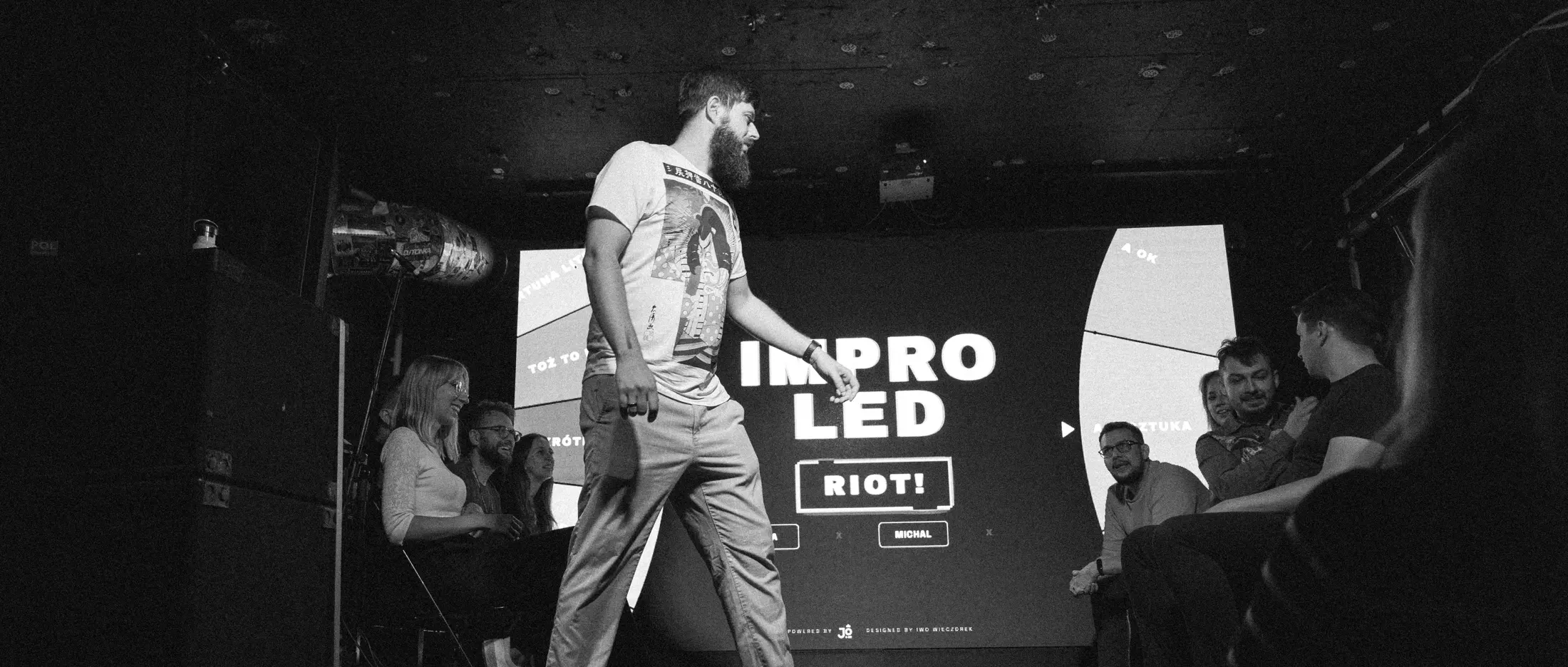
00 — Run the Show
Nobody wakes up on a Wednesdaythinking: I need to see improv on Monday.
Three books and ninety-eight working files on running a small theatre — the audience, the team, the season. Written by people who had to.
Twelve people.Then eleven.
We ran a show for twelve people, went home, and decided to rehearse harder. Then we ran a better show — for eleven.
The show was fine. What was missing was everything around it: a path we designed for the audience instead of hoping for one, roles written down before names went in them, a season planned like a product rather than a list of dates.
Fifteen years later the room sells out. This is what we wrote down on the way.
Three books
01
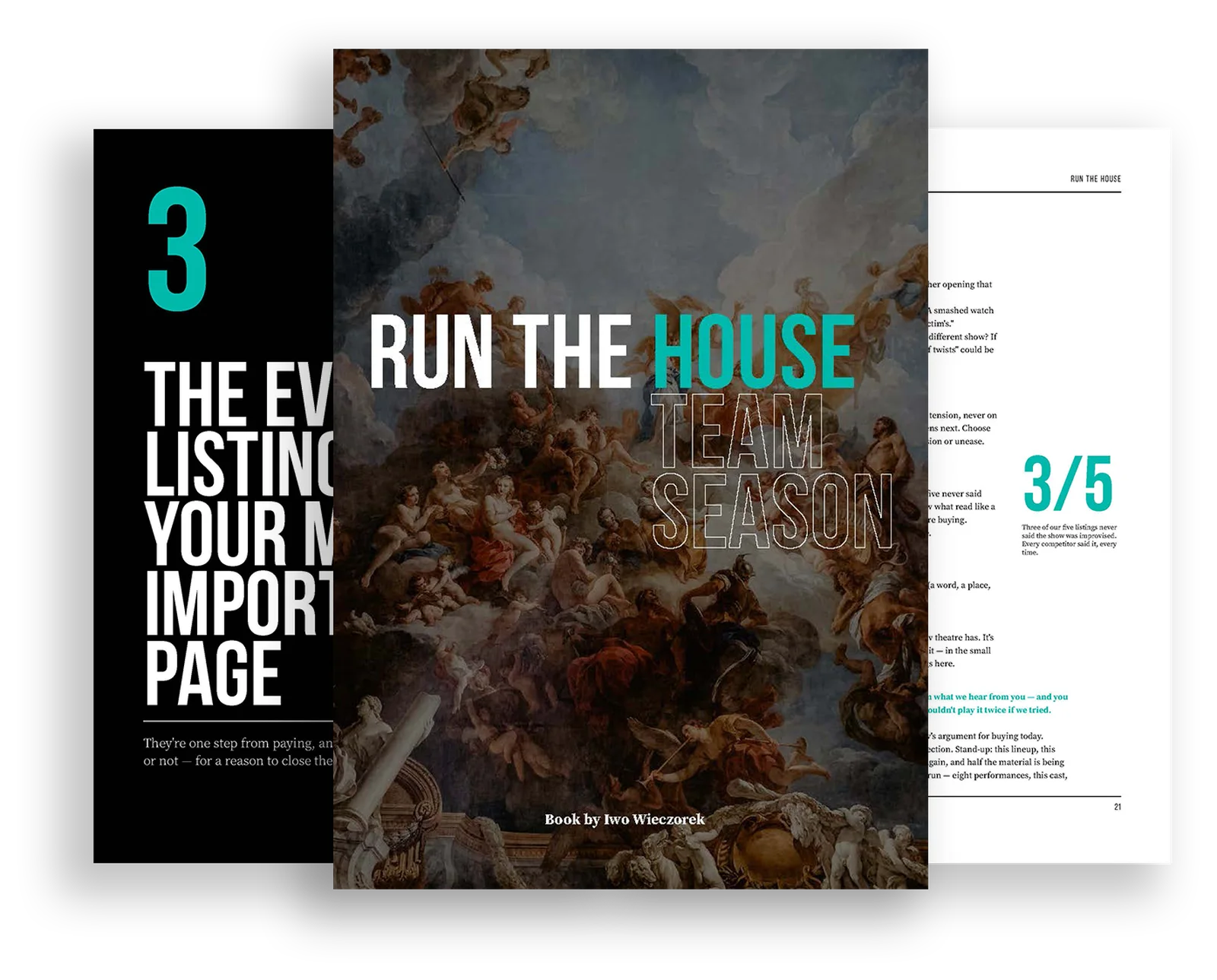
Run the House
The audience. The path from stranger to regular, the listing that sells, the one ad campaign worth running, the five numbers to read every month.
13 chapters · 17 files
02
Run the Team
The people. Roles before names, who decides what, money inside a group where nobody is on payroll, and the four hours of a show night.
15 chapters · 21 files
03
Run the Season
The year. The catalogue, the spacing, the calendar, the ledger, the contracts — and the management panel a non-programmer built with AI.
12 chapters · 11 files
Forty chapters
The full contents of all three books. Hover a title for what the chapter argues.
Run the House
Book one · the audience · 13 chapters
- 00Why nobody comes (and why it's not the show)Improv is demand you create. Nobody wakes up needing to see it, so the ad has to make the appetite, and the best channel is a person who already came.
- 01The number everything depends onBefore you spend a cent, work out what one ticket is worth after costs and how much you can pay to sell it. Everything else in the book follows from that figure.
- 02Your audience's path — six touchpointsReach, interest, purchase, the wait, the night, the return. Most theatres only work on the first. The cheapest wins sit in the last two.
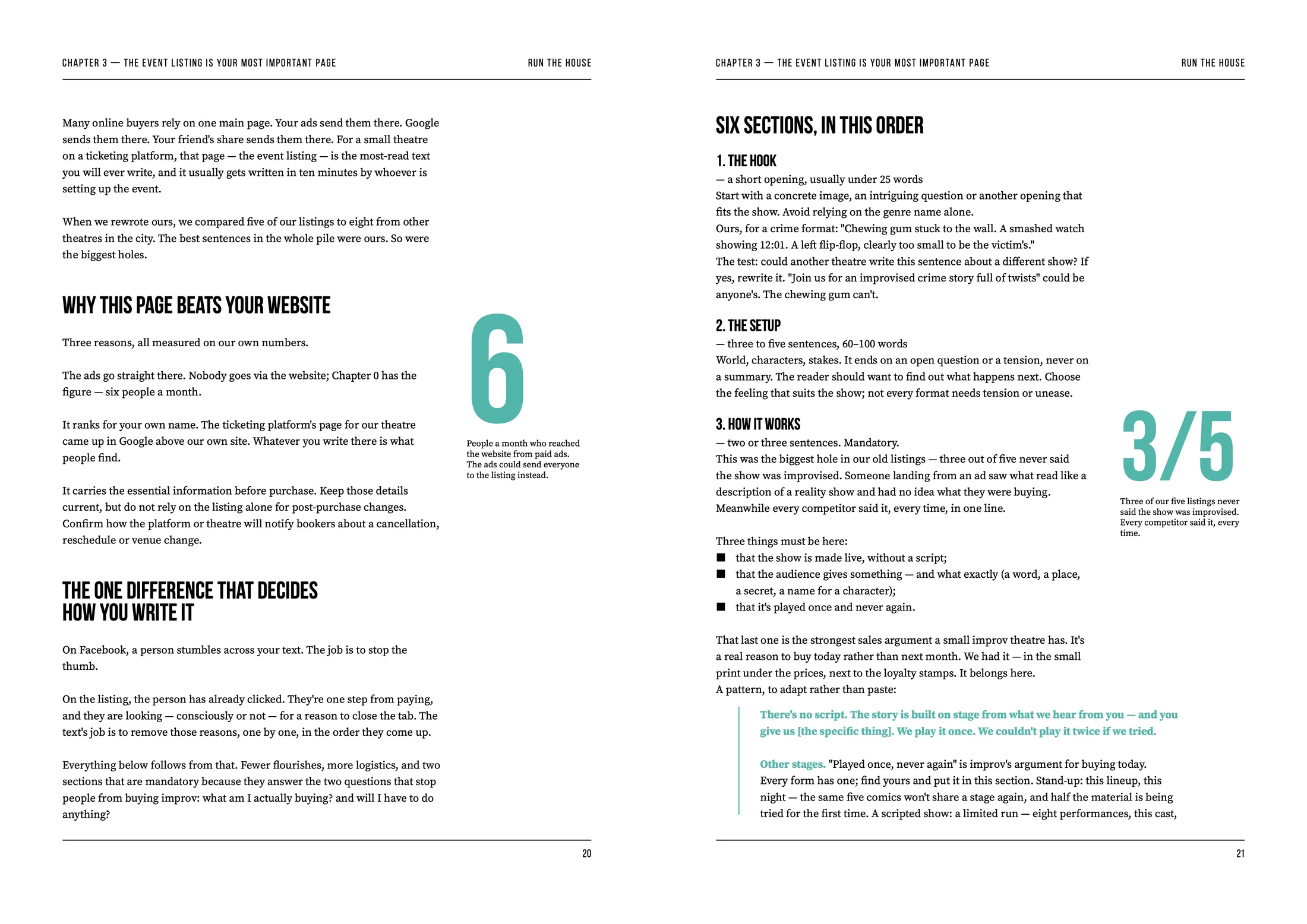
- 03The event listing is your most important pageThe event page on the ticketing platform is the one page every buyer sees. A standard for writing it: hook, what happens, who it's for, the practical bits, zero theatrical fog.
- 04Google: the business profile and its eventsThe free page Google shows before yours: hours, category, photos, a reply to every review, and event posts that tidy themselves away after the show.
- 05A website that does one jobShow the programme and send people to tickets. Everything else is image. Splash screens, autoplay and clever menus cost you people — measured, not guessed.
- 06SEO for a theatre — what it can and can't doSearch will not sell you tickets. It can make you findable once someone has heard the name, and build your standing in the field. Write about craft, not about the city.
- 07Social without burning outSocial in a theatre with no payroll is a people problem. A rhythm you can keep, a split between two people, Facebook events as duty rather than extra.
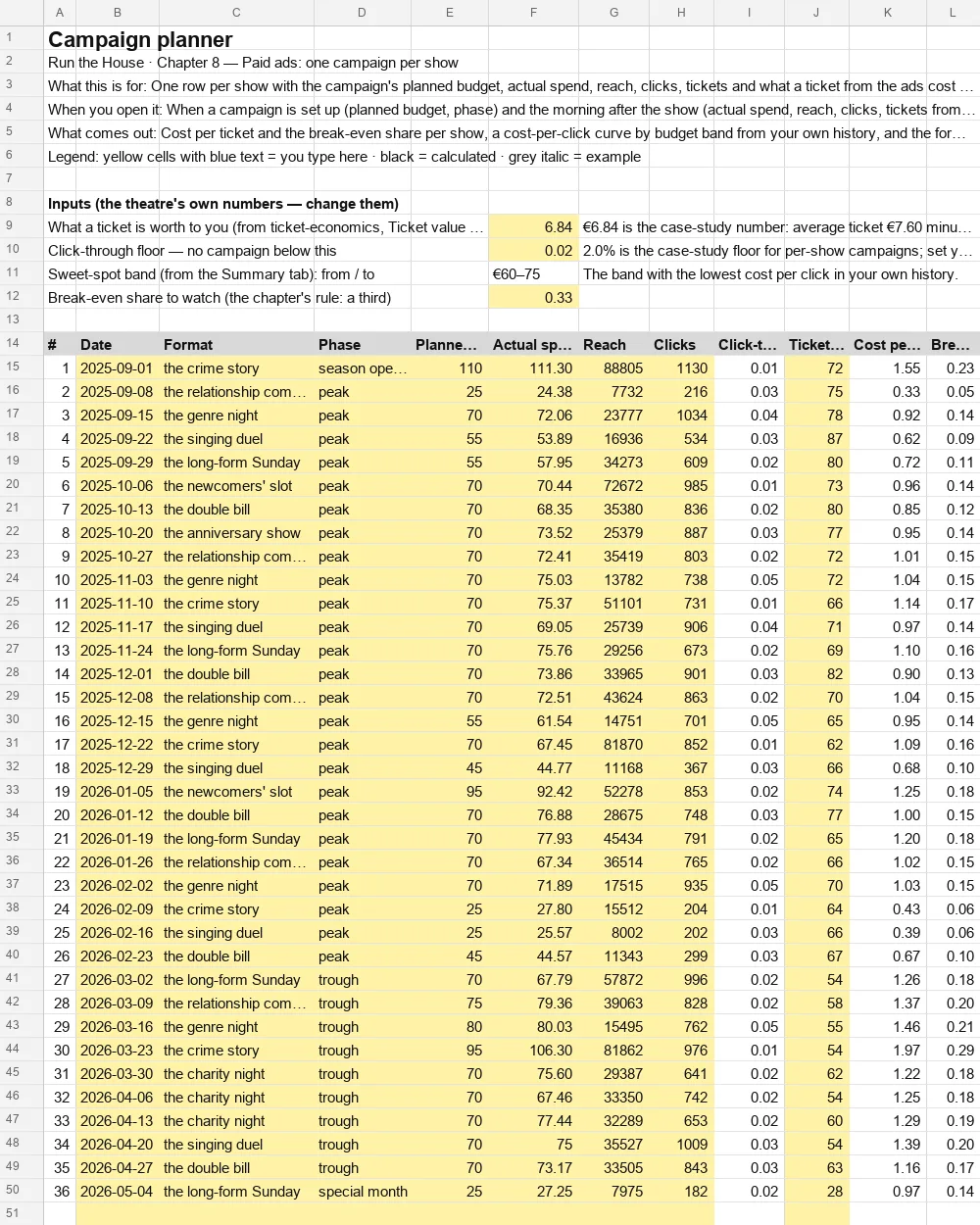
- 08Paid ads: one campaign per showOne campaign per show, a budget that moves with the month of the season, and a creative that matters more than the money: click-through varies sevenfold between formats.
- 09Pixels, retargeting and the email you're not allowed to sendThe pixel goes on the ticketing platform, because your site is not in the path to purchase. And check what you are actually allowed to do with the buyer list.
- 10Reviews, vouchers and the return visitThe cheapest ticket goes to someone who already came. A QR code at the happiest moment of the night, vouchers with a distribution plan, fewer free seats.
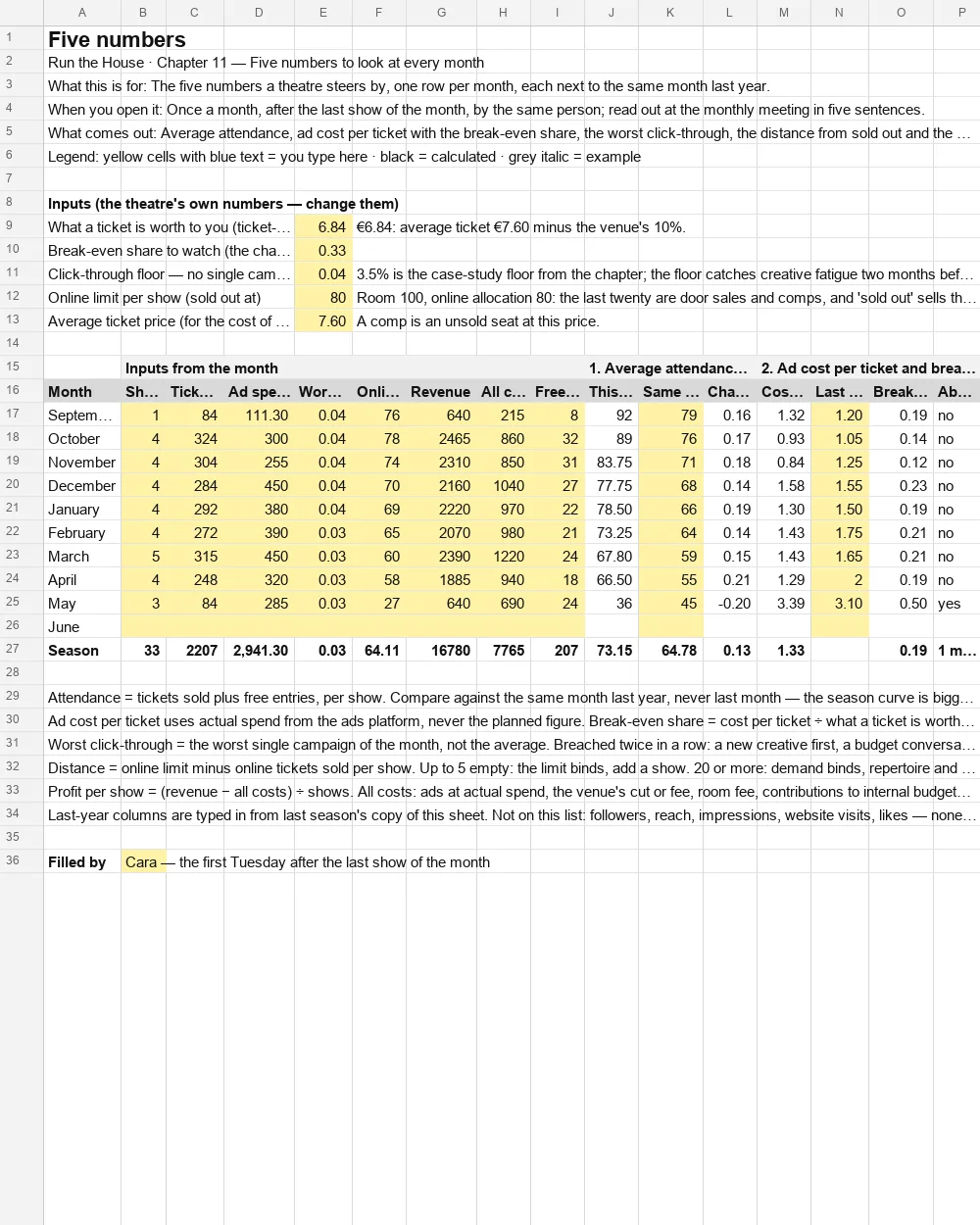
- 11Five numbers to look at every monthAttendance per show, cost per ticket from ads, creative click-through, distance from sold out, phase of the season. November and May are two different jobs.
- 12What we deliberately don't doFlyers, outdoor, Google Ads, satisfaction surveys, a phone number on the profile, chat, renaming for keywords. Each one: why not, and what instead.

Run the Team
Book two · the people · 15 chapters
- 00Nobody's on payroll (and that's the whole problem)You cannot fire, promote or outrank anyone. Everything that holds a company together you have to build from rules, rhythm and honest money.
- 01Roles before peopleFirst the list of functions the theatre needs to play at all, then the names. Each function gets a card: purpose, weekly duties, a number to watch, who covers when someone drops out.
- 02Who decides whatThree columns: who checks, who decides, who executes. Most things go through the meeting and execution comes back to the leader, so every idea costs him twice.
- 03The rhythm: monthly, season, annualA monthly with statuses, one season meeting before the start, one annual for prices and budget. Someone other than the leader keeps the minutes.
- 04Rules that survive a fightWrite the rules while everyone is calm, because in a conflict nobody can agree on them. One overriding principle, rights, duties, a cascade of consequences, a reset.
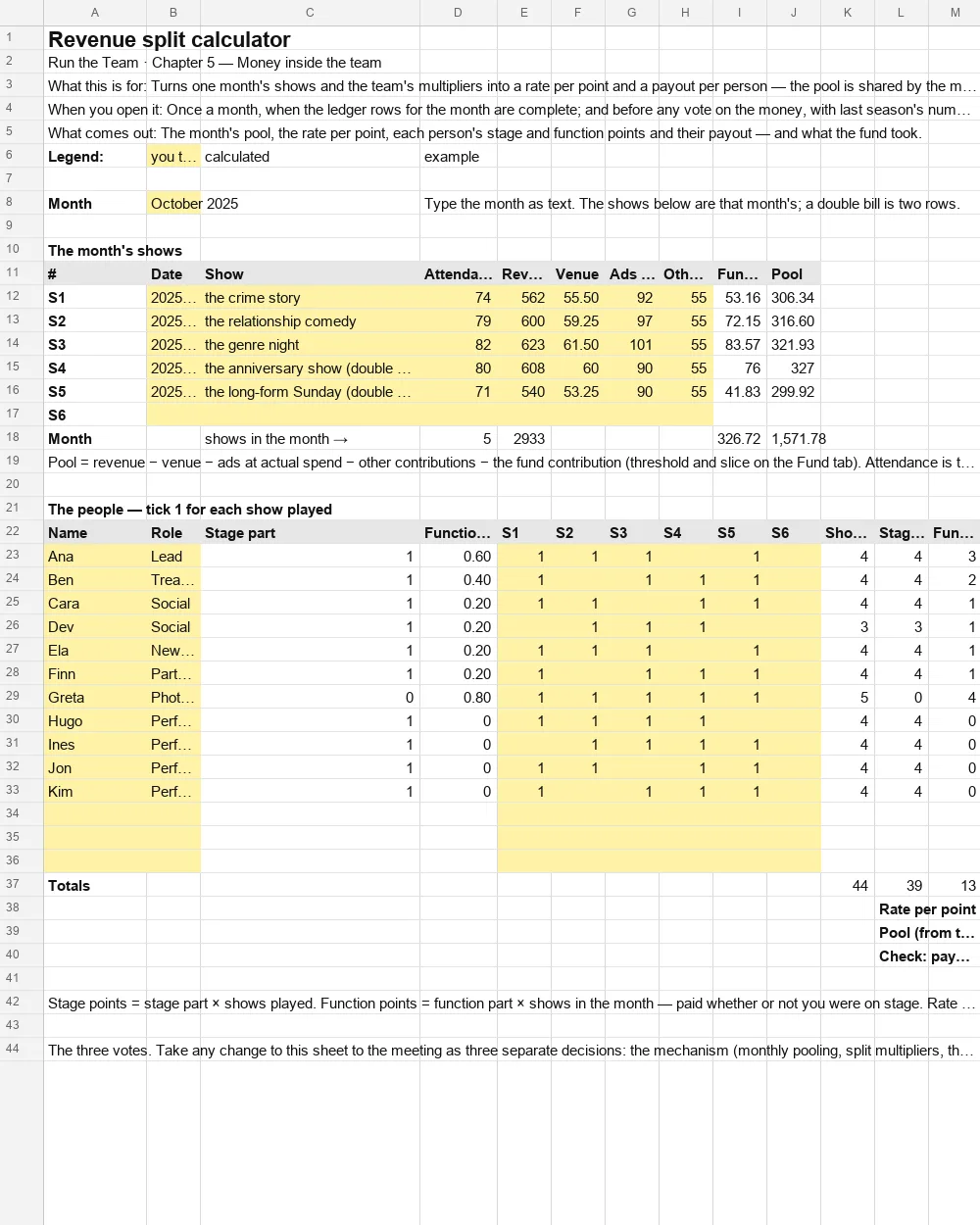
- 05Money inside the teamHow to split show revenue between people who play for love: a flat rate per show, multipliers for functions, a buffer for thin months, a break-even line.
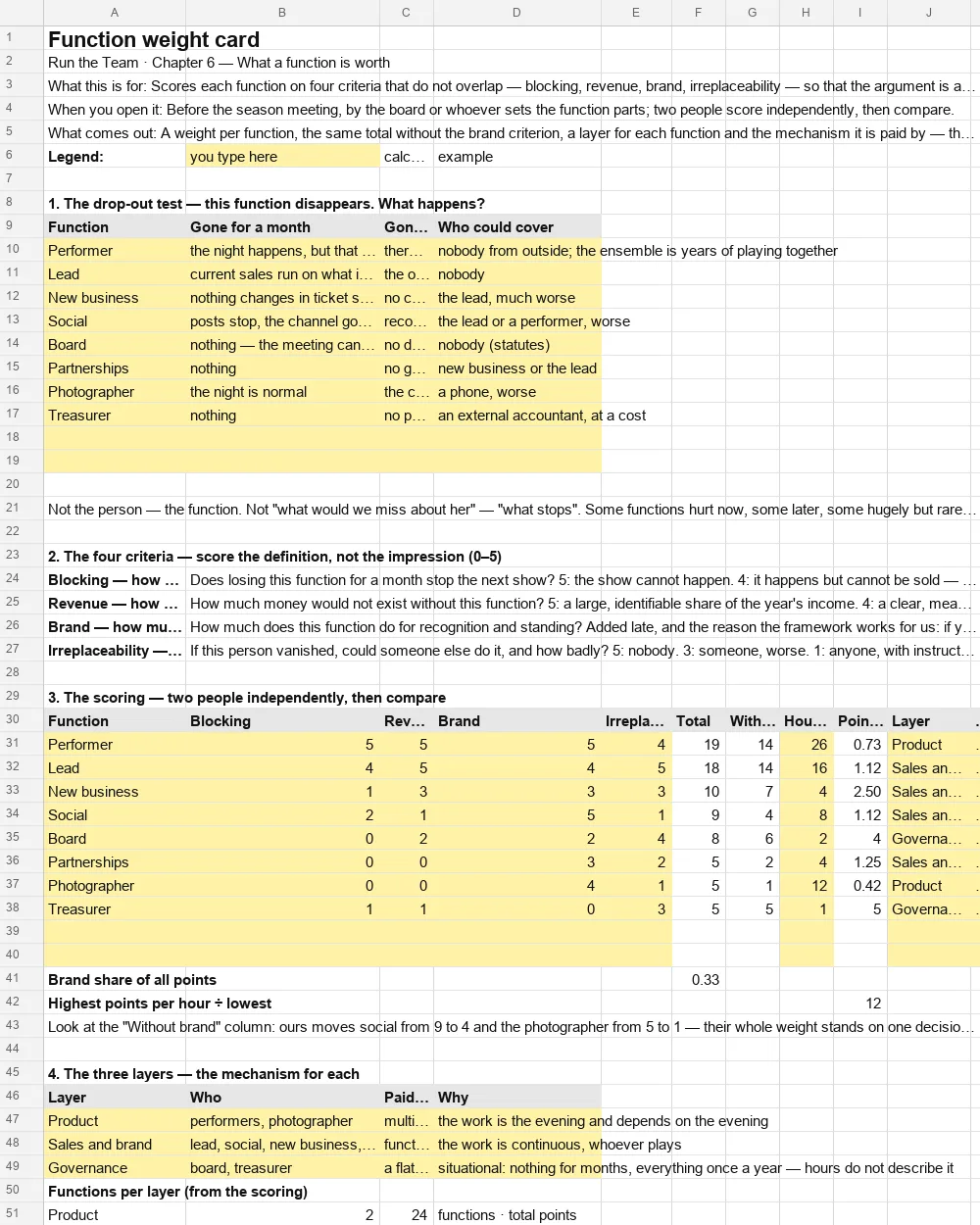
- 06What a function is worthThe absence test: what happens if this person disappears for a month. Four criteria, scored 0–5. The weight is an argument in a conversation about pay, and nothing more.
- 07The hourly truthCount the team's real hourly rate. Ours came out far below minimum wage, and the multipliers turned out to be an hourly system in disguise. Log two months of hours before you open this conversation.
- 08Single points of failureEvery critical function held by one person is an outage that has not happened yet. The fix is a procedure: an access register, checklists, a second person on everything that matters.
- 09Joining, leave, leavingRecruiting through a rehearsal, onboarding with a role card, leave the rules never mentioned, and a parting that can happen without a war.
- 10When to say noThe list of things you deliberately do not do matters more than the task list. And never promise numbers or dates in public that you have not confirmed.
- 11Talking to the teamLeading an unpaid group is mostly talking. A map of channels, feedback after a show, at rehearsal and one to one, and a pulse survey twice a year.
- 12Growing the teamWhat makes people stay and grow: rituals, an education fund (it existed, it worked, we closed it — both halves of the story), and individual plans nobody imposes.
- 13The night itself: from 17:30 to the last chairSeven functions every show night needs and four answers to who does them: the venue, someone hired, a member, nobody. Then exactly how we run ours.
- 14The leader's own pay, and the rest of itThe leader has a conflict of interest in every conversation about money. Someone else presents the numbers. Three separate votes: mechanism, amounts, exceptions.
Run the Season
Book three · the year · 12 chapters
- 00A season is a productA season has a start, an end, a peak and a trough. Treated as a product it can be designed: when to premiere, when to play the specials, when to stop.
- 01Your formats as a catalogueEvery format has a category, a cast, a length, a sales history and a wear level. Which ones sell, which are used up, which stay as rehearsal exercises.
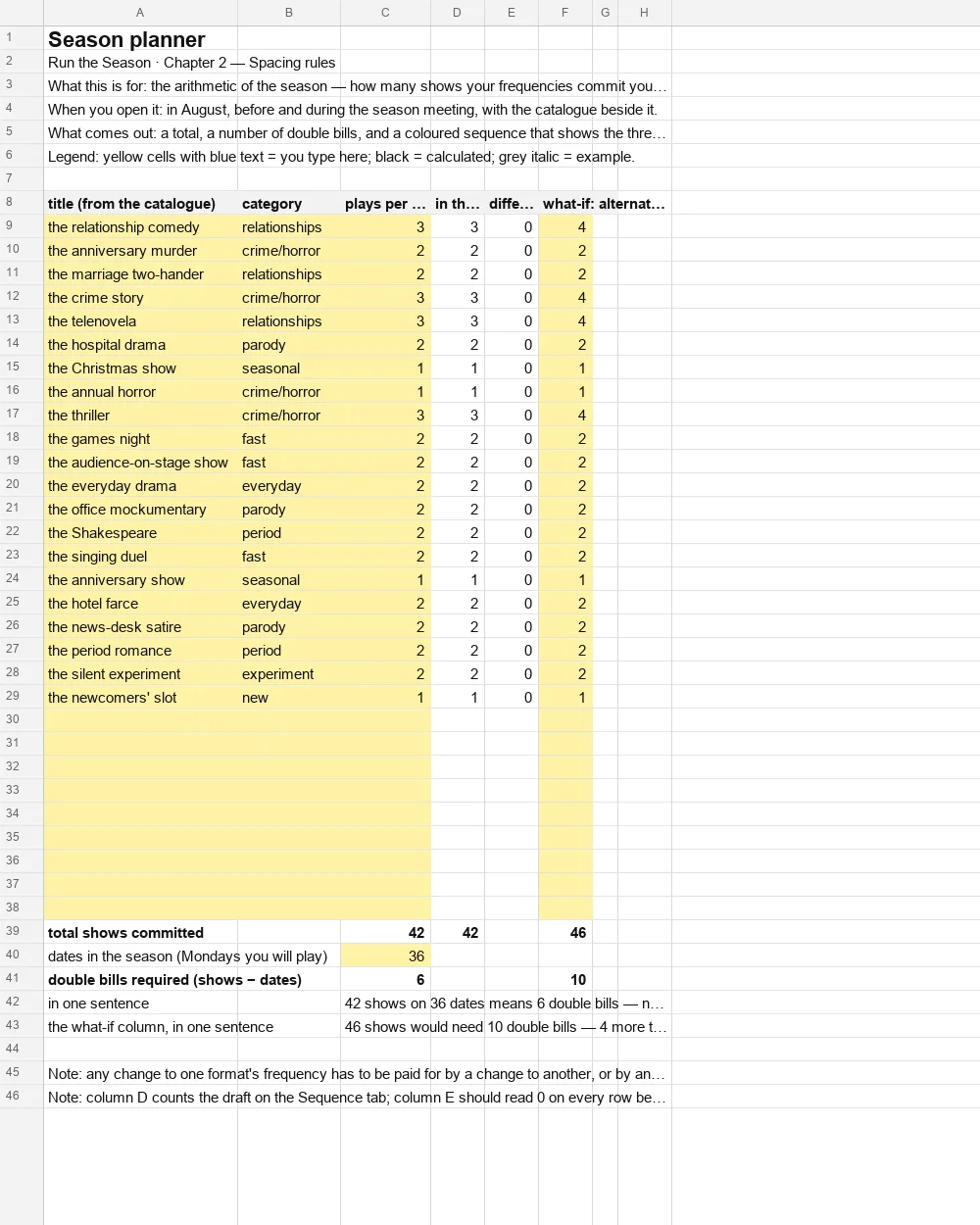
- 02Spacing rulesThe same format at least five shows apart, the same category at least three. Heuristics for building a plan from zero. The team's decision after discussion is final.
- 03Building the calendarThe pool of dates closes to the last slot: every extra show of one format is paid for with one fewer of another. The calendar gets checked by machine for what nobody checks by hand.
- 04Pricing and capacityThree prices, a premium for chosen nights, presale as a tool rather than a discount. A hundred seats, eighty sold online — and from eighty we say sold out.
- 05Reading the numbersThe end-of-season report: attendance per show and per format, seasonality, cost per ticket from ads, what sells itself and what needs a campaign.
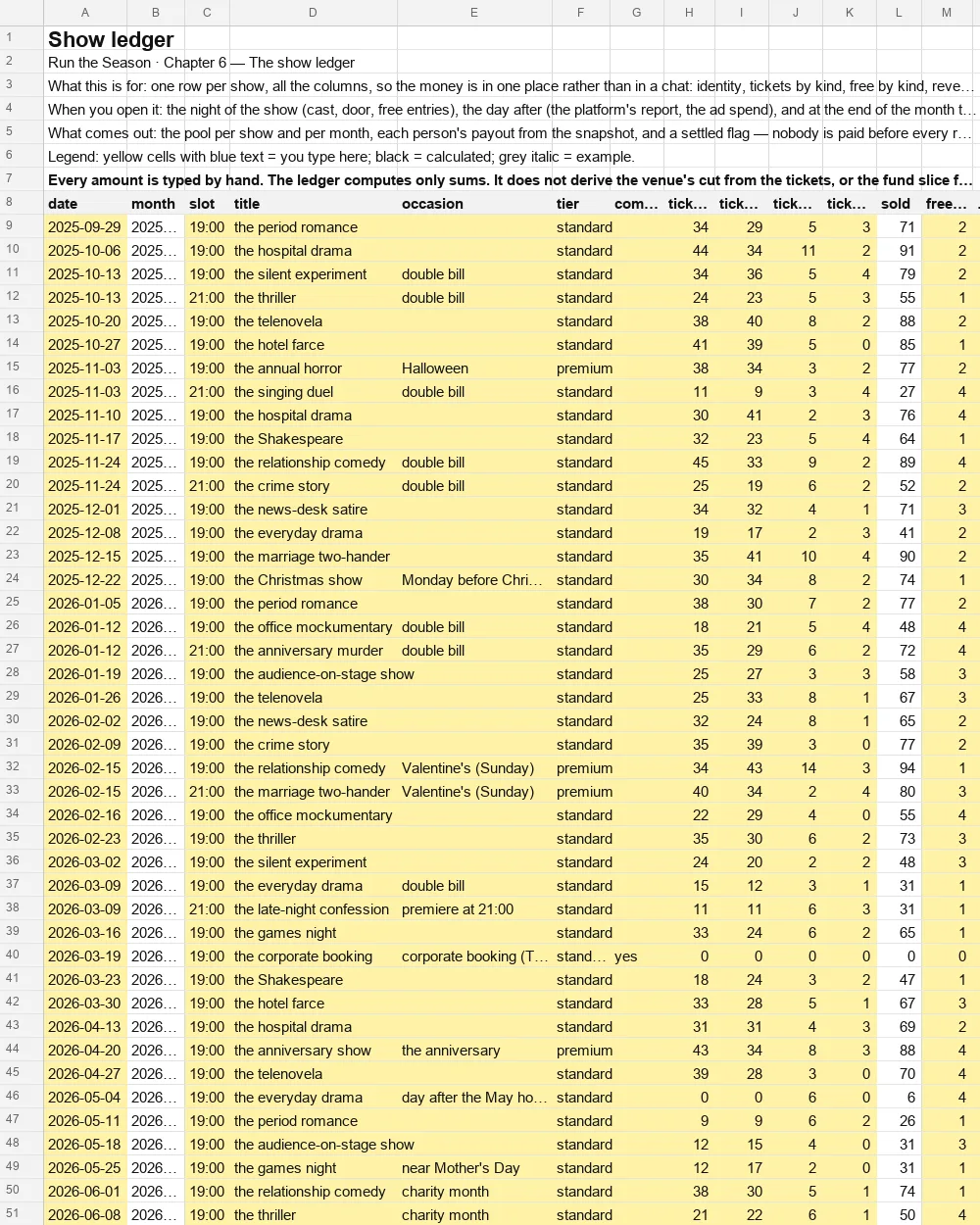
- 06The show ledgerOne row per show: sold, free, revenue, costs broken out, the pool to split, payouts, settlement status. Without it the money lives on the group chat.
- 07Contracts and payoutsA contract in five statuses, a performer questionnaire, agreements generated from a database, payouts tied to the ledger. Sensitive data typed only by the person it belongs to.
- 08The archive: five years in one tableEvery show since day one: date, title, cast, sold, revenue. One tile with the total earned, and the conversation about money changes tone.
- 09From spreadsheet to panelThe ladder: spreadsheet, database, your own app. When to climb a rung, and what our panel actually does.
- 10Building your own panel with AI (no developer)A non-technical person can build a theatre panel with AI today, provided they start from a specification, never hand over passwords or live data, and test it themselves. How we did it, and the traps that cost days.
- 11What we didn't buildThe short list of things deliberately missing from our system: a musician's threshold, a satisfaction survey, a newsletter from the ticket base, a mobile app. Why not, and what would change that.
Ninety-eightworking files
Spreadsheets and documents, not PDFs. Every one in two versions: empty, and filled with a whole example season so you can see what "done" looks like.
Forty-nine templates across the three books. Formulas already in the cells, a header in every file saying what it is for and when you open it.
See the full list — 49 templates, 98 files
Run the House · 17
- ticket-economicsxlsx
- audience-path-mapxlsx
- event-listing-standarddocx
- google-profile-checklistdocx
- google-event-post-templatedocx
- review-repliesdocx
- theatre-website-blueprintdocx
- event-schemajson
- keyword-mapxlsx
- publishing-calendarxlsx
- social-roles-splitdocx
- campaign-plannerxlsx
- pixel-setup-checklistdocx
- consent-registerxlsx
- review-qr-flowdocx
- voucher-distribution-planxlsx
- five-numbersxlsx
Run the Team · 21
- role-carddocx
- decision-matrixxlsx
- monthly-agendadocx
- season-meeting-agendadocx
- performer-agreement-templatedocx
- revenue-split-calculatorxlsx
- function-weight-cardxlsx
- hours-logxlsx
- access-and-backup-registerxlsx
- onboarding-checklistdocx
- leave-agreementdocx
- offboarding-checklistdocx
- not-doing-listxlsx
- communication-channels-mapdocx
- feedback-carddocx
- team-pulse-surveydocx
- white-board-worksheetdocx
- education-fund-rulesxlsx
- individual-strategydocx
- season-rituals-calendarxlsx
- show-night-run-sheetxlsx
Run the Season · 11
- format-cataloguexlsx
- season-plannerxlsx
- season-calendarxlsx
- pricing-and-capacityxlsx
- season-reportxlsx
- show-ledgerxlsx
- contract-flowdocx
- show-archivexlsx
- tool-ladder-decisiondocx
- panel-spec-starterdocx
- build-safety-checklistdocx
05 — Read a chapter first
Read itbefore you buy it
Chapter 3 of Run the House — the event listing, the page that sells more tickets than any ad you will ever buy. Eight pages, plus the listing standard as a file you can use this week.
No sequence of twelve emails. The chapter, and a note when the next book lands.
Who wrote this
Iwo Wieczorek runs a hundred-seat improv theatre that has played every Monday since 2011. He teaches improv, lectures in marketing at a university, and leads brand at an agency by day.
He is not a programmer. That did not stop him building the theatre's management panel — accounts, schedule, ledger, contracts, a five-year archive — in evenings, with an AI assistant. Chapter 10 of the third book is exactly how.

Get the books
Every book comes with its files. Updates to the files reach everyone who bought, automatically, for as long as the books exist.
One book
€39
One volume and its working files. House, Team or Season — you choose in the checkout.
12–15 chapters · 11–21 files
Choose a book
Two books
€69
Any two of the three, with their files. Pick the pair in the checkout.
2 × €39 = €78 · two for €69
Choose two
The set
€89
All three books and all ninety-eight files. The audience, the team, the season.
3 × €39 = €117 · the set €89
Get the set
Before you buy
Fourteen days
If the files are not what you expected, write to me and you get your money back. I would rather refund you than have you recommend this to nobody.
What this is not
A guide to improvising. A management textbook. A promise of numbers — ours are ours, yours will differ. And there is no code in the books or in the pack, deliberately.